New Core Program
The DOE recently consolidated the management of the SBIR/STTR programs to the Office of Technology Commercialization (OTC), reflecting DOE’s focus on moving taxpayer-funded research toward real-world impact. The SBIR/STTR programs align directly with OTC’s mission to accelerate commercialization, streamline innovation pathways, and strengthen engagement between small businesses and the DOE National Laboratory system. This transition reinforces DOE’s commitment to improving operational efficiency and investing in technological advancements towards energy dominance. The DOE SBIR program is now being Administered by ConnectWerx (CWX) under DOE Office of Technology Commercialization (OTC).
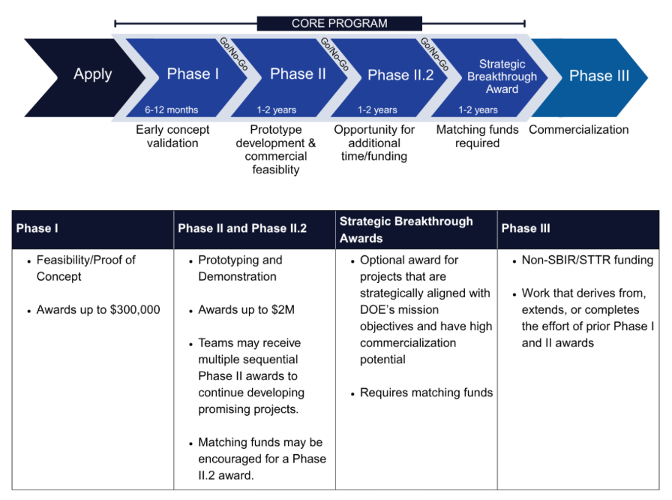
DOE’s new SBIR/STTR programs will follow the phases illustrated below. Participants will submit a single application to enter the program and may progress to subsequent phases through a series of Go/No-Go decision points. Therefore, once the initial application is submitted, no additional applications will be required. Instead, participants will advance through subsequent phases at their own pace by successfully meeting established milestones and performance criteria.
What is the Genesis Mission Phase I?
Genesis Mission is the first Phase I opportunity under OTC’s new management of the DOE SBIR/STTR programs, using a new streamlined, applicant-focused process. A broader Phase I covering additional technology topics will follow later this summer.
Genesis Mission SBIR Funding: ~40 awards, $10M total for Phase I, representing up to $44M in cumulative SBIR/STTR funding across the projects’ lifecycles.
Two-Stage Process
- Pitch application first (mandatory gate). A short “elevator pitch” — 4 open-text questions with strict word counts. Only invited pitches proceed. Link here to template. Within the DOE SBIR/STTR Application Hub coming soon, each small business can enter up to three pitches.
- Full application by invitation only. Missing the pitch window or being declined makes you ineligible for the full application.
Locked after pitch: Topic and applicant small business cannot change; slight title changes are allowed.
If invited, before a company can SUBMIT the full application, the invited small business will need to have registered with the System for Award Management (SAM) and with Small Business Administration (SBA) Company Registry.
Four Topic Areas (Pitches must align to one of these 4 topics)
- Scaling the Biotechnology Revolution — AI for biotech, biochemicals, bioproducts (biomolecular design, genotype-phenotype, microbiome engineering, bioreactor/biomanufacturing, genome engineering).
- Realizing Quantum Systems for Discovery — AI for quantum computing/networking (decoherence mitigation, error correction, QPU control, resource estimation, verification, workflow orchestration across classical HPC/AI/quantum).
- Designing Materials with Predictable Functionality — AI frameworks for “inverse design” of advanced materials.
- Achieving AI-Driven Autonomous Laboratories — AI in experimental workflows (advanced robotics, AI for Network Operations, diagnostics, remote handling, neuromorphic computing primitives).
Evaluation Criteria (four, equally weighted)
- Summary, Topic & Mission Alignment (100 words) — fit to chosen topic and DOE priorities.
- Technical Promise (200 words) — significance, innovation, and feasibility within the proposed timeline/budget.
- Commercialization Potential (200 words) — value proposition, competitive advantage, go-to-market strategy.
- Team Qualifications (200 words) — company experience, partnerships, and credible follow-on funding plan.
Note: expert reviewer scores are advisory; the DOE Selection Official makes final decisions and may apply program policy factors beyond scores.
Key Dates
- Wed 7/22: Announced; applicants can request access to the Acquisition Management Portal (AMP).
- Mid-August: AMP applications open; two virtual Office Hours sessions with DOE and ConnectWerx
- Thu 9/10, 2:00 PM ET: Applications close on the AMP. Late submissions not accepted; files can be updated/replaced until the deadline.
Submission Mechanics
- Submit via the AMP portal (application link “coming soon”).
- Draft the 4 pitch answers offline and paste in — strict word counts.
- Optional (not required): Bibliography & References Cited document.
- File requirements: PDF only, ≤5MB, print-capable, no password, no special characters in filenames. No ZIP or other formats.
What is the FY25 Phase II Opportunity?
ConnectWerx, a Partnership Intermediary of the U.S. Department of Energy (DOE), has opened an initial funding opportunity in collaboration with the Office of Technology Commercialization for up to $147,394,250 for Small Business Innovation Phase II awards.
This opportunity will be open to awardees who completed a DOE SBIR/STTR Phase I, Phase II, or follow-on Phase II award in FY24 or FY25. SBIR/STTR Awardees who applied to a subtopic under one of the following topics in DOE’s SBIR FY24 Phase I Release 2 Opportunity are eligible to apply for the current Phase II opportunity:
Topic Area 1 – AI, Quantum, Advanced Sensing and Risk Mitigation for Energy Security
Topic Area 2 – Modernizing the Grid and Advanced Energy Storage
Topic Area 3 – Next-Generation Nuclear and Waste Management Solutions
Topic Area 4 – Industrial Processes and Carbon Innovation
Topic Area 5 – Critical Minerals and Materials Innovation
Topic Area 6 – Energy Technology Innovation
Key Dates
- Wed 7/22: Announced; applicants can request access to the Acquisition Management Portal (AMP).
- Mid-August: AMP applications open; two virtual Office Hours sessions with DOE and ConnectWerx
- Thu 9/25, 12:00 PM ET: Applications close on the AMP. Late submissions not accepted; files can be updated/replaced until the deadline.
How to Apply
Complete the online application and upload the appropriate project information and supporting documentation in the application link below. Key project components required for all applications are indicated in the table below. Applicants are encouraged to download this Checklist for a full list of possible uploads, requirements, and resources that will be part of the application and to reference the FAQs for additional questions.
Files shall be submitted in Adobe Acrobat (.pdf) format, unless otherwise specified, and not be larger than 5MB. ZIP files and other application formats are not acceptable. All files shall be print-capable, without a password. Filenames must contain the appropriate extension and shall not contain special characters.
The following elements are required:
- Project Narrative Note: 12 page limit, minimum size 12 font
- Commercialization Plan Note: 10 page limit, minimum size 12 font
- Pitch Video
- Cash Flow Pro-Forma
- Project Team Partner Information
- Project Team Member Current & Pending Support
- Project Team Member CV/Biosketches (SciENcv NSF format)